

When your vehicle starts suffering from strange electrical problems, the Body Control Module (BCM) is often the hidden culprit. From central locking failures and dashboard warning lights to electric window malfunctions, a faulty BCM can cause a wide range of frustrating issues.
One of the first questions vehicle owners ask is:
“Should I repair my BCM or replace it entirely?”
The answer depends on the severity of the fault, but in many cases, repairing your existing BCM can save hundreds of pounds compared to a full replacement.
What Is a Body Control Module?
The Body Control Module acts as the electronic control centre for many of your vehicle’s non-engine systems. It manages:
- Central locking
- Electric windows
- Interior and exterior lighting
- Wipers
- Indicators
- Alarm systems
- Immobiliser functions
- Power mirrors
Because the BCM communicates with multiple vehicle systems, even a small fault can create multiple symptoms across your car.
Common Signs of BCM Failure
If you’re experiencing any of the following issues, your BCM could be at fault:
1. Central Locking Problems
Doors may fail to lock or unlock properly, or the system may work intermittently.
2. Lighting Faults
Headlights, indicators, brake lights, or interior lights may behave unpredictably.
3. Electric Window Malfunctions
Windows may stop responding or operate without warning.
4. Battery Drain
A failing BCM can continue drawing power even when the vehicle is switched off.
5. Dashboard Warning Lights
Multiple warning lights appearing simultaneously often indicate communication issues within the vehicle’s electronic network.
Why Dealerships Often Recommend Replacement
Many dealerships follow a replace-only approach because it is faster and requires less component-level diagnosis.
A new BCM often requires:
- Purchasing a new module
- Programming and coding
- Vehicle-specific configuration
- Immobiliser synchronisation
This can significantly increase repair costs.
When BCM Repair Is the Better Choice
In many cases, BCM faults are caused by:
- Water damage
- Corrosion
- Failed solder joints
- Voltage spikes
- Component failure on the circuit board
These issues can often be repaired without replacing the entire module.
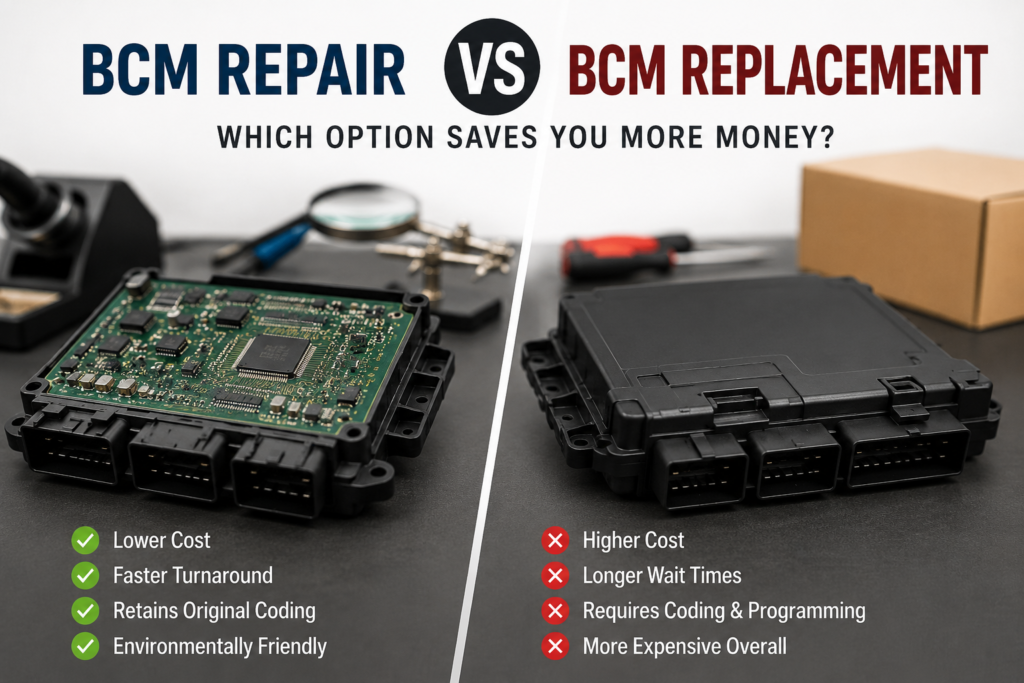
Benefits of BCM repair include:
Lower Costs
Repairing the original unit is usually much cheaper than sourcing and programming a new module.
Faster Turnaround
Many repairs can be completed within days rather than waiting for replacement parts.
Retains Original Vehicle Coding
Keeping the original BCM avoids many of the compatibility and coding issues associated with replacement modules.
Environmentally Friendly
Repairing electronics reduces waste and extends the lifespan of existing components.
When BCM Replacement Is Necessary
Replacement may be required when:
- The module has suffered severe physical damage.
- Internal circuitry is beyond economical repair.
- Previous repair attempts have failed.
- The unit is missing or has been heavily modified.
In these cases, professional recoding and programming are essential to ensure proper integration with the vehicle.
How Professional Diagnostics Can Save You Money
Many vehicle owners replace expensive parts unnecessarily because electrical faults can mimic BCM failure.
Professional diagnostics can identify whether the issue is actually caused by:
- Wiring faults
- Poor earth connections
- Faulty sensors
- ECU communication problems
- Battery or charging system issues
Accurate testing prevents unnecessary replacement costs and ensures the correct repair is carried out first time.
Final Thoughts
A faulty BCM doesn’t automatically mean you need an expensive replacement. In many situations, professional diagnostics and component-level repairs can restore full functionality while saving substantial money.
If you’re experiencing electrical faults, central locking issues, battery drain, or intermittent electronic problems, having your BCM professionally tested is often the quickest and most cost-effective solution.
The sooner the fault is diagnosed, the greater the chance of a successful repair and the lower the overall cost.