
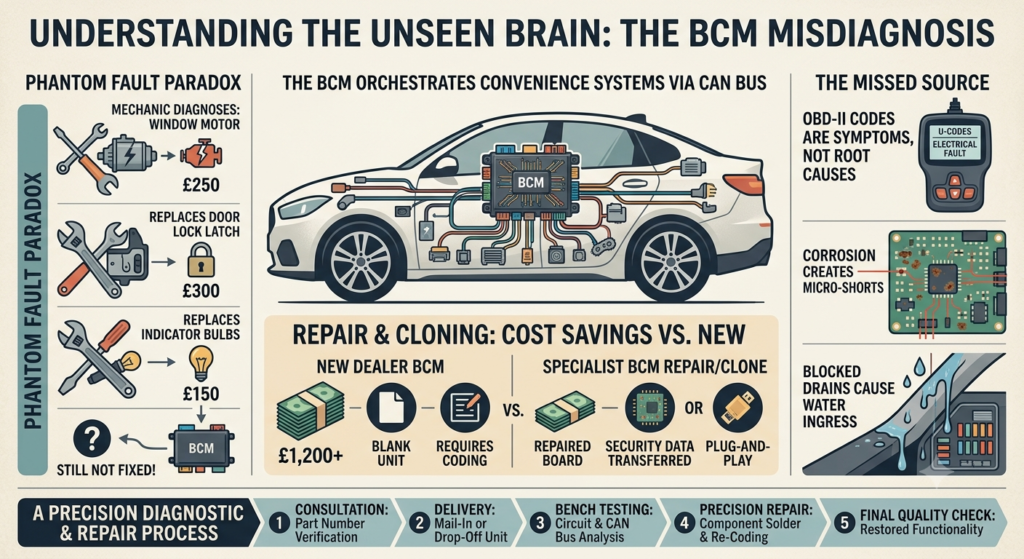
Imagine this scenario: you take your car to a garage because the driver’s side window won’t roll up.
The mechanic replaces the window motor. £250 spent.
Three days later, the central locking starts locking and unlocking itself while you’re driving. The garage replaces the door lock latch. Another £300 spent.
Next week, the indicators start hyper-flashing, and the wiper blades refuse to turn off.
Suddenly, you’ve spent over £500 on parts that were completely fine — while the true culprit sits quietly behind the glovebox, untouched.
The Phantom Fault Paradox
Modern cars suffer from what auto electricians call The Phantom Fault Paradox. Because every convenience system — lights, locks, wipers, immobiliser, windows — passes through a single computer called the Body Control Module (BCM), a single failed capacitor inside that module mimics dozens of individual hardware failures.
When a standard garage plugs in a basic OBD-II fault reader, it reads symptoms, not root causes:
-
Code says “Driver Window Circuit Open” $\rightarrow$ Mechanic swaps the motor.
-
Code says “Passenger Door Actuator Voltage Low” $\rightarrow$ Mechanic swaps the latch.
Unless the technician specializes in module diagnostics, they treat the symptoms and miss the source.
The Reality: Replaced mechanical hardware won’t fix a vehicle when the brain telling those parts how to behave is suffering from corrosion, solder cracking, or software corruption.
How Water Ingress Silently Destroys BCMs
You don’t need to drive through a flood to ruin your car’s electronics. The vast majority of BCM failures sent to our workbench are caused by tiny, unnoticed design flaws:
| Common Water Ingress Vector | What Actually Happens Inside the Module |
| Blocked Sunroof Drains | Rainwater backs up into the A-pillars and drips directly into the footwell fuse box/BCM area. |
| Clogged Windscreen Plenum Chambers | Leaves block the engine bay drain holes, forcing water through the firewall wiring grommets. |
| Leaking Rear Tail Light Seals | Moisture creeps into rear-mounted body modules (common in estate cars and SUVs). |
Once water hits microscopic circuit traces, electrolysis begins. Even after the water dries up, corrosion eats through copper paths, causing random signal shorts across completely unrelated car systems.
Don’t Pay Main Dealer Prices for a Blank Slate
If a dealership eventually identifies a bad BCM, their standard response is simple: “That will be £1,200 for a new unit, plus coding fees, and a 3-week wait from the factory.”
What they don’t mention is that repairing or cloning your existing unit is almost always possible at a fraction of that cost.
       [ FAULTY BCM ]
             │
      ┌──────┴──────┐
      ▼             ▼
MAIN DEALER      BCM REPAIR SPECIALIST
 • £1,200+        • Fraction of dealership cost
 • Blank unit     • Original software preserved
 • Extra coding   • Plug-and-Play refit
 • Weeks wait     • 24-48h turnaround
By repairing the existing board or transferring your car’s unique security data directly to a refurbished donor module, your keys, mileage, and immobiliser sync remain completely untouched.
Stop Guessing. Get Precision Diagnostics.
If your vehicle is exhibiting multiple “random” electrical glitches, don’t let a garage throw expensive parts at the problem.
At Body Control Module Repair UK, we test, repair, and clone BCM and ECU units for trade garages and car owners nationwide with fast 24–48 hour turnarounds.
-
Free Tech Support & Quotations: Call 0800 043 6161
-
Send Your Unit Direct: bodycontrolmodulerepair.co.uk